Description
General System Description
The EcHoLas is a holographic printer that produces true 3D holographic images by recording thousands of microscopic holographic elements, known as hogels, with extreme precision. Unlike conventional analogue holography systems that require physical objects and high energy lasers for single-shot optical exposure, the printer employs weak lasers to generates the hologram directly from digital 3D data, building the image hogel-by-hogel to create a fully immersive volumetric light field with realistic 3D depth, parallax, and spatial realism. Since information for digital 3D hologram is obtained from digital pictures pixels – the hologram itself always has pixelated nature, which in our case are not visible. The hogel size is tunable, which size of those can be from 100×100 µm to 500 x 500 µm. Each hogel contains information from 600-1200 usual pixels with corresponding coordinates that are taken from different views of 3D scene imprinted.
The Volume Hologram Origination System is supplied with important software packages:
- EcHoLas printer control software (GUI)
- Data generation software for Full Parallax holograms
- Data preview software for Single Parallax holograms
- Data preview software for Full Parallax holograms
Typical specifications*
| DESCRIPTION | PARAMETER | NOTES |
|---|---|---|
| Laser wavelengths | 640 / 532 / 457 nm | Different laser wavelengths can be implemented on request. |
| Laser type** | CW | Pulsed green 532nm laser can also be implemented on request. |
| Maximum area printed | ~200 × 200 mm | Bigger printing area can be extended by implementing pulsed laser on request. |
| Hogel printing resolution (PC tunable) | ~100 – 500 µm | Printer is based on hogel recording, which size is simple tunable via GUI The <150 µm hogels are already invisible for naked eye. |
| Printing speed*** | ~1 – 3 Hz | Master hologram printing speed depends on light sensitive material characteristic. Using pulsed lasers recording speed can be either 30 Hz or 60 Hz |
| Holographic material type | Photopolymers | Silver Halide emulsion plates could also be applicable. |
| Field Of View (FOV) | ~20 – 100 degrees | The bigger the FOV the dimmer the hologram |
| Digital hologram type | Full color (RGB) Volume 3D reflection Single and Full Parallax | With possibility also record and individual monochrome or two-color or full-color holograms. Including gradient color creation. |
| Hologram recording-replay geometry (reference angle / lighting) | ~45° or 0° | Table Top 0° (360° view) or ~45° view |
| Digital hologram data imprinted | Static or Dynamic (animated) | File sequences made by 3D programs (Blender, 3D StudioMax, etc.) or Live world data capture. |
| Data preparation program | Blender | Other programs can be also applicable for Single Parallax data sequence preparation. The Full parallax – only Blender. |
| Electrical requirements of machine | 220 VAC 50/60 Hz, ~200 W | The power consumptions depend on laser power and it is subject to change. |
| Software provided along with device | – Printer Control – Data processing (preparation) – Data Preview | – Software which allows to control digital printer – The “Rendering Farmer” software, which allows to prepare data allowing multiple computers (“Cows”) use for network rendering. – Software which makes preview of desired data (Single & Full parallax) |
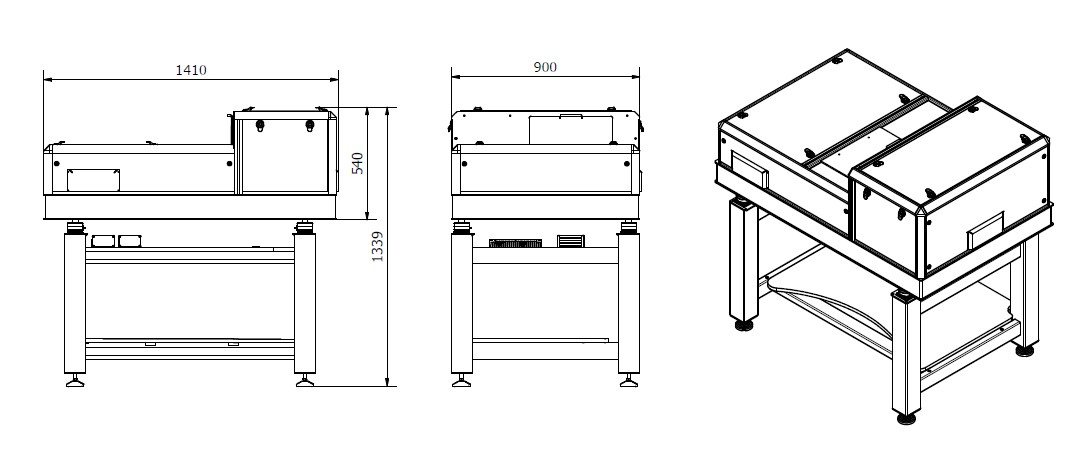
| Size of the machine (preliminary) | 900 × 1339 × 1410 mm | |
| Warranty | 12 / 3 months | General / Optics respectively |
* Parameters marked typical are not specifications. They are indications of typical performance and they will vary with each unit we manufacture.
** The pulsed laser can also be employed with RGB (660, 532 and 440nm) wavelength however it requires extra R&D phase for its implementation.
*** The speed depends on lasers type used CW or Pulsed.
System Dimensions
Hologram Data Preparation
Digital scene for the hologram can be created and rendered with computer aided design program such like Blender, 3D Studio Max, Maya, etc.
For the data rendering you will need:
- Download iLumogram rendering parameters calculator for Windows (zip ~121kB)
- Download iLumogram files preparation manual for 3D Studio Max
or
- Download iLumogram files preparation manual for Blender
After creating your files, please send them to us using any of file transfer services – WeТransfer, SwissTransfer, etc.. After reviewing your files we will create iLumogram preview, so you will be able to see how your iLumogram will look like on your computer screen.